


Can Technology Finally Deliver on the Data-Driven Promise?
For more than two decades, organisations have pursued the promise of becoming “data-driven.”
The promise was compelling:
- Objective, fact-based decisions
- Real-time visibility
- A single source of truth
- Democratised access to insights
- AI-enabled competitive advantage
Yet the reality has often been different
- Strategic decisions are still political.
- Metrics are adjusted to fit narratives.
- Dashboards explain what already happened.
- Trust in data remains conditional.
We became data-rich, but decision-poor.This is not a tooling problem; it is a structural one.
The Illusion We Bought
For years, organisations invested in platforms, reporting layers and AI pilots. When problems persisted, we added more tools. But the underlying conditions never changed:
- Data complexity continued to grow in volume, velocity, variety and veracity; human cognitive capacity did not.
- Governance existed as policy rather than as an embedded capability.
- Metadata was maintained manually.
- Ownership was unclear.
- Data lineage was partial.
Foundational work was postponed in favour of visible outcomes. Unresolved foundations do not remain stable. They compound.
This is why failure rates in data and IT initiatives remain high. Not because organisations lack ambition. But because they try to scale intelligence atop instability.
What Is Fundamentally Different Today?
For the first time, we are at a genuine inflection point. Three forces have converged
- Infrastructure is scalable and economically viable.
- Computational models can reason across complex information spaces.
- Governance and modelling disciplines are mature.
We never had these together before. The constraint is no longer storage. It is no longer processing power. The constraint is structural coherence. The bottleneck has shifted from processing to thinking. And that shift changes everything.
The Thinking Enterprise
The next five years will separate organisations that automate reporting from those that automate understanding.
The thinking enterprise recognises that humans cannot sustainably:
- Curate metadata at scale
- Maintain lineage manually
- Reconcile inconsistencies across dozens of systems
- Preserve context across domains.
These activities exceed human bandwidth. So the enterprise redesigns its foundation.
Systems assist with:
- Understanding data
- Maintaining context
- Classifying information
- Surfacing real issues
Humans focus on:
- Judgement
- Trade-offs
- Strategy
- Accountability
Governance becomes embedded in use, not enforced through bureaucracy. AI is not layered on top; it is integrated at the core.
Measuring What Matters
In the next phase of maturity, organisations must confront a difficult question:
Are we measuring data activity or decision quality?
A data-driven organisation measures whether decisions improve:
- Forecast error over time
- The percentage of strategic initiatives stopped early due to evidence
- Decision reversal rate, etc.
These are uncomfortable metrics, but they reveal behavioural change. Of course, the foundation metrics are still needed, but it’s important to remember that these are enablers and not the goal:
- Data quality metrics (accuracy, completeness, timeliness, etc.)
- Lineage coverage
- Metadata completeness
- Data trust index, etc.
These metrics explain why decision metrics improve or don’t.
These metrics must be embedded in existing governance systems, such as KPIs, Balanced Scorecards, and Risk Reviews. Not as a data department initiative, but as an enterprise capability.
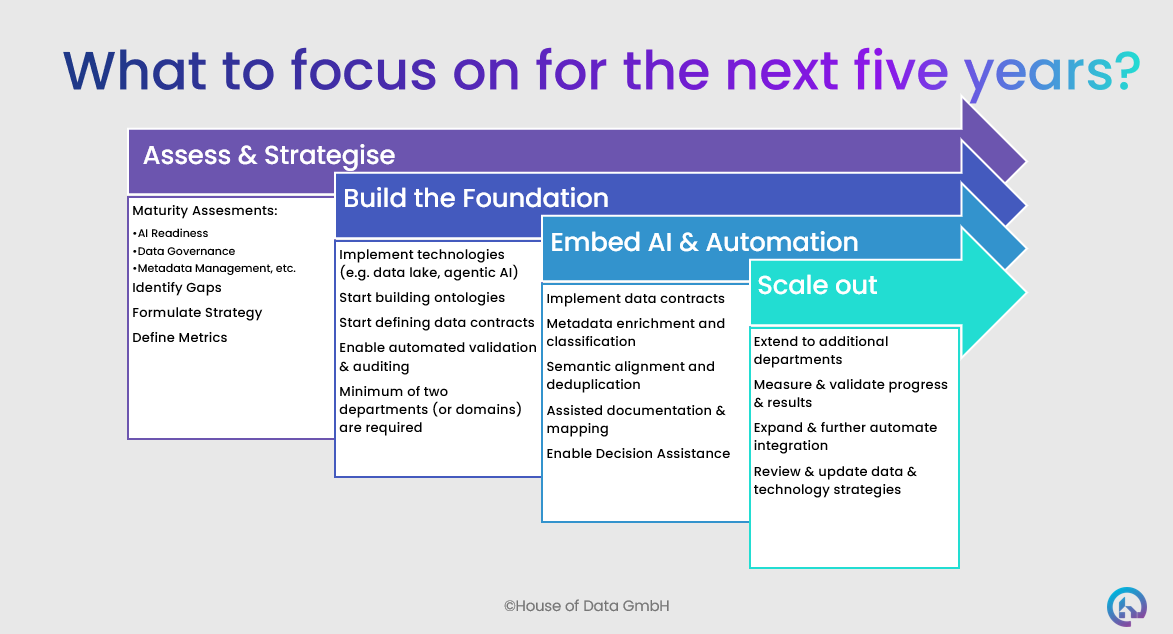
A Practical Focus for the Next Five Years
Preparing for the next five years does not begin with selecting an AI vendor. It begins with clarity.
Assess and Strategise
- Assess maturity in AI Readiness, Data Governance, Metadata management, etc.
- Identify foundational gaps
- Formulate a strategy and define success metrics
Build the foundation
Stabilise the core before scaling intelligence. Build mechanisms that
- Implement technologies (e.g. data lake, agentic AI)
- Formalise data meaning (start building ontologies and defining data contracts)
- Enforce accountability
- Enable automated validation
- Support contextual reasoning
Only then does embedding AI create a durable advantage.
Embed AI and Automation
- Implement data contracts
- Semantic alignment and deduplication
- Assisted documentation and mapping
- Enable decision assistance
And once embedded, scale deliberately, extending capabilities across domains while continuously measuring impact.
Without foundation, AI accelerates fragility. With the foundation, AI accelerates learning.
The Real Question
The real question organisations should ask is not
Which model should we deploy?
But
Is our organisation stru cturally capable of thinking at scale?
The next five years will not reward the most enthusiastic adopters of AI. They will reward the organisations that fix their foundations first. Technology can now operate closer to human reasoning than ever before, but it cannot compensate for structural incoherence. That responsibility remains human.

Leave a Reply